NATIONWIDE PROTESTS AGAINST racist policing have brought new scrutiny onto big tech companies like Facebook, which is under boycott by advertisers over hate speech directed at people of color, and Amazon, called out for aiding police surveillance. But Microsoft, which has largely escaped criticism, is knee-deep in services for law enforcement, fostering an ecosystem of companies that provide police with software using Microsoft’s cloud and other platforms. The full story of these ties highlights how the tech sector is increasingly entangled in intimate, ongoing relationships with police departments.
Microsoft’s links to law enforcement agencies have been obscured by the company, whose public response to the outrage that followed the murder of George Floyd has focused on facial recognition software. This misdirects attention away from Microsoft’s own mass surveillance platform for cops, the Domain Awareness System, built for the New York Police Department and later expanded to Atlanta, Brazil, and Singapore. It also obscures that Microsoft has partnered with scores of police surveillance vendors who run their products on a “Government Cloud” supplied by the company’s Azure division and that it is pushing platforms to wire police field operations, including drones, robots, and other devices.
Genetec offers cloud-based CCTV and big data analytics for mass surveillance in major U.S. cities. Veritone provides facial recognition services to law enforcement agencies. And a wide range of partners provide high-tech policing equipment for the Microsoft Advanced Patrol Platform,
With partnership, support, and critical infrastructure provided by Microsoft, a shadow industry of smaller corporations provide mass surveillance to law enforcement agencies.
which turns cop cars into all-seeing surveillance patrols. All of this is conducted together with Microsoft and hosted on the Azure Government Cloud.
Last month, hundreds of Microsoft employees petitioned their CEO, Satya Nadella, to cancel contracts with law enforcement agencies, support Black Lives Matter, and endorse defunding the police. In response, Microsoft ignored the complaint and instead banned sales of its own facial recognition software to police in the United States, directing eyes away from Microsoft’s other contributions to police surveillance. The strategy worked: The press and activists alike praised the move, reinforcing Microsoft’s said position as a moral leader in tech.
Yet it’s not clear how long Microsoft will escape major scrutiny. Policing is increasingly done with active cooperation from tech companies, and Microsoft, along with Amazon and other cloud providers, is one of the major players in this space.
Because partnerships and services hosting third party vendors on the Azure cloud do not have to be announced to the public, it is impossible to know full extent of Microsoft’s involvement in the policing domain, or the status of publicly announced third party services, potentially including some of the previously announced relationships mentioned below.
Microsoft: From Police Intelligence to the Azure Cloud
In the wake of 9/11, Microsoft made major contributions to centralized intelligence centers for law enforcement agencies. Around 2009, it began working on a surveillance platform for the NYPD called the Domain Awareness System, or DAS, which was unveiled to the public in 2012. The system was built with leadership from Microsoft along with NYPD officers.
While some details about the DAS have been disclosed to the public, many are still missing. The most comprehensive account to date appeared in a 2017 paper by NYPD officers
.
The DAS integrates disparate sources of information to perform three core functions: real-time alerting, investigations, and police analytics.
Through the DAS, the NYPD watches the personal movements of the entire city. In its early days, the system ingested information from closed-circuit TV cameras, environmental sensors (to detect radiation and dangerous chemicals), and automatic license plate readers, or ALPRs. By 2010, it began adding geocoded NYPD records of complaints, arrests, 911 calls, and warrants “to give context to the sensor data.” Thereafter, it added video analytics, automatic pattern recognition, predictive policing, and a mobile app for cops.
By 2016, the system had ingested 2 billion license plate images from ALPR cameras (3 million reads per day, archived for five years), 15 million complaints, more than 33 billion public records, over 9,000 NYPD and privately operated camera feeds, videos from 20,000-plus body cameras, and more. To make sense of it all, analytics algorithms pick out relevant data, including for predictive policing.
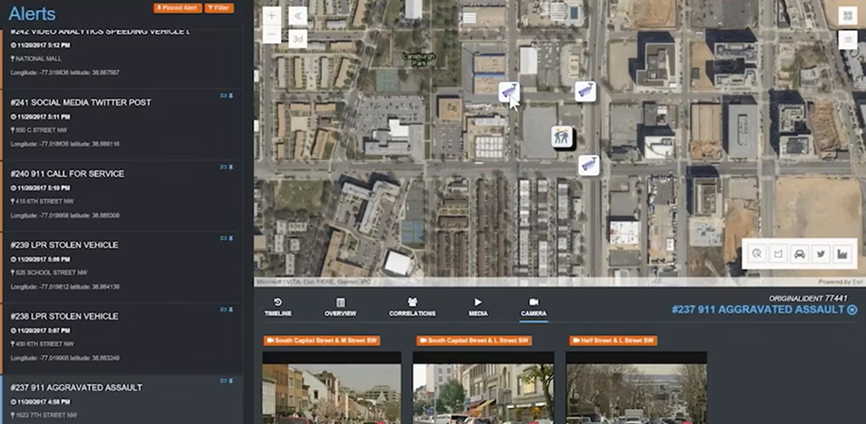
Image: Microsoft presentation

The NYPD has a history of police abuse, and civil rights and liberties advocates like Urban Justice Center’s Surveillance Technology Oversight Project have protested the system out of constitutional concerns, with little success to date.
While the DAS has received some attention from the press — and is fairly well-known among activists — there is more to the story of Microsoft policing services.
Over the years, Microsoft has grown its business through the expansion of its cloud services, in which storage capacity, servers, and software running on servers are rented out on a metered basis. One of its offerings, Azure Government, provides dedicated data hosting in exclusively domestic cloud centers so that the data never physically leaves the host country. In the U.S., Microsoft has built several Azure Government cloud centers for use by local, state, and federal organizations.
Unbeknownst to most people, Microsoft has a “Public Safety and Justice” division with staff who formerly worked in law enforcement. This is the true heart of the company’s policing services, though it has operated for years away from public view.
Microsoft’s police surveillance services are often opaque because the company sells little in the way of its own policing products. It instead offers an array of “general purpose” Azure cloud services, such as machine learning and predictive analytics tools like Power BI (business intelligence) and Cognitive Services, which can be used by law enforcement agencies and surveillance vendors to build their own software or solutions.
Microsoft’s Surveillance-Based IoT Patrol Car
The NYPD has a history of police abuse, and civil rights and liberties advocates like Urban Justice Center’s Surveillance Technology Oversight Project have protested the system out of constitutional concerns, with little success to date.
While the DAS has received some attention from the press — and is fairly well-known among activists — there is more to the story of Microsoft policing services.
Over the years, Microsoft has grown its business through the expansion of its cloud services, in which storage capacity, servers, and software running on servers are rented out on a metered basis. One of its offerings, Azure Government, provides dedicated data hosting in exclusively domestic cloud centers so that the data never physically leaves the host country. In the U.S., Microsoft has built several Azure Government cloud centers for use by local, state, and federal organizations.
Unbeknownst to most people, Microsoft has a “Public Safety and Justice” division with staff who formerly worked in law enforcement. This is the true heart of the company’s policing services, though it has operated for years away from public view.
Microsoft’s police surveillance services are often opaque because the company sells little in the way of its own policing products. It instead offers an array of “general purpose” Azure cloud services, such as machine learning and predictive analytics tools like Power BI (business intelligence) and Cognitive Services, which can be used by law enforcement agencies and surveillance vendors to build their own software or solutions.
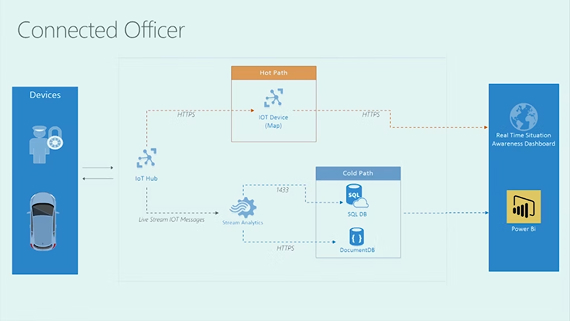
Microsoft’s Connected Officer simulation demo for IoT surveillance and data integration for real-time situational awareness and centralized police analytics. Photo taken from Microsoft presentation, “The Connected Officer: Bringing IoT to Policing,” by Jeff King and Brandon Rohrer.
Image: Microsoft presentation
According to this concept, a multitude of surveillance and IoT sensor data is sent onto a “hot path” for fast use in command centers and onto a “cold path” to be used later by intelligence analysts looking for patterns. The data is streamed along through Microsoft’s Azure Stream Analytics product, stored on the Azure cloud, and enhanced by Microsoft analytics solutions like Power BI — providing a number of points at which Microsoft can make money.

Text next to the image Text next to the image Text next to the image Text next to the image Text next to the image Text next to the image Text next to the image Text next to the image Text next to the image Text next to the image Text next to the image Text next to the image Text next to the image Text next to the image Text next to the image
H4 style here
While the “Connected Officer” was a conceptual exercise, the company’s real-world patrol solution is the Microsoft Advanced Patrol Platform, or MAPP. MAPP is an IoT platform for police patrol vehicles that integrates surveillance sensors and database records on the Azure cloud, including “dispatch information, driving directions, suspect history, a voice-activated license plate reader, a missing persons list, location-based crime bulletins, shift reports, and more.”
The MAPP vehicle is outfitted with gear from third-party vendors that stream surveillance data into the Azure cloud for law enforcement agencies. Mounted to the roof, a 360-degree high-resolution camera streams live video to Azure and the laptop inside the vehicle, with access also available on a mobile phone or remote computer. The vehicle also sports an automatic license plate reader that can read 5,000 plates per minute — whether the car is stationary or on the move — and cross-check them against a database in Azure and run by Genetec’s license plate reader
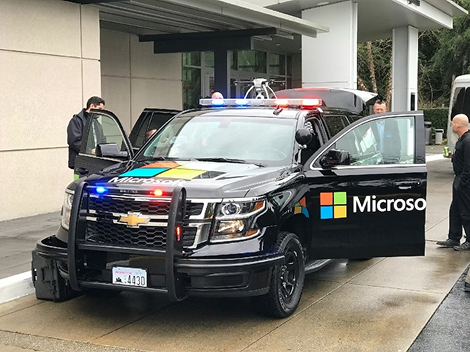
Photo: Microsoft Azure blog
A demo of the Microsoft Advanced Patrol Platform, or MAPP, IoT surveillance vehicle for police. An Aeryon Labs SkyRanger is perched on top.
Photo taken from Microsoft Azure blog, “Microsoft hosts Justice & Public Safety leaders at the 2nd annual CJIS Summit,” by Rochelle Eichner
solution, AutoVu. A proximity camera on the vehicle is designed to alert the officers when their vehicle is being approached.
Patrolling the skies is a drone provided by Microsoft partner Aeryon Labs, the SkyRanger, to provide real-time streaming video. (Aeryon Labs is now part of surveillance giant FLIR Systems.) According to Nathan Beckham of Microsoft Public Safety and Justice, the vehicle’s drones “follow it around and see a bigger view of it.” The drones, writes DroneLife, can “provide aerial views to the integrated data platform, allowing officers to assess ongoing situations in real time, or to gather forensic evidence from a crime scene.”
Police robots are also part of the MAPP platform. Products from ReconRobotics, for example, “integrat[ed] with Microsoft’s Patrol Car of the Future Program” in 2016. Microsoft says ReconRobotics provides their MAPP vehicle with a “small, lightweight but powerful robot” that “can be easily deployed and remotely controlled by patrol officers to provide real-time information to decision-makers.”
Another Microsoft partner, SuperDroid Robots, has also announced they will provide the Microsoft MAPP vehicle with two compact remote-controlled surveillance robots, the MLT “Jack Russell” and the LT2-F “Bloodhound,” the latter of which can climb stairs and obstacles.
Microsoft says “the car is becoming the nerve center for law enforcement.”
Although it sports a Microsoft insignia on the hood and door, the physical vehicle the company uses to promote MAPP isn’t for sale by Microsoft, and you probably won’t see Microsoft-labeled cars driving around. Rather, Microsoft provides MAPP as a platform through which to transform existing cop cars into IoT surveillance vehicles: “It’s really about being able to take all this data and put it up in the cloud, being able to source that data with their data, and start making relevant information out of it,” said Beckham.
Indeed, Microsoft says “the car is becoming the nerve center for law enforcement.” According to Beckham, the information collected and stored in the Azure cloud will help officers “identify bad actors” and “let the officers be aware of the environment that is going on around them.” As an example, he said, “We’re hoping with machine learning and AI in the future, we can start pattern matching” with MAPP vehicles providing data to help find “bad actors.”
Last October, South African police announced Microsoft partnered with the city of Durban for “21st century” smart policing. Durban’s version of the the MAPP solution includes a 360-degree ALPR to scan license plates and a facial recognition camera from Chinese video surveillance firm Hikvision for use when the vehicle is stationary (e.g., parked at an event)
According to South African news outlet ITWeb, the metro police will use the MAPP solution “to deter criminal activities based on data analysis through predictive modeling and machine learning algorithms.” The vehicle has already been rolled out in Cape Town, where Microsoft recently opened a new Azure data center — an extension of the digital colonialism I wrote about in 2018.
Microsoft: Powering CCTV and Police Intelligence in the City
Beyond wiring police vehicles, video surveillance provides another lucrative source of profits for Microsoft, as it is loaded with data packets to transmit, store, and process — earning fees each step of the way.
When building a CCTV network packed with cameras, cities and businesses typically use a video management system, or VMS, to do things like display multiple camera feeds on a video wall or offer the option to search through footage. A leading VMS provider, Genetec, offers the core VMS integrated into Microsoft’s Domain Awareness System. A close partner of Microsoft for over 20 years, the two companies work together on integrating surveillance services on the Azure cloud.


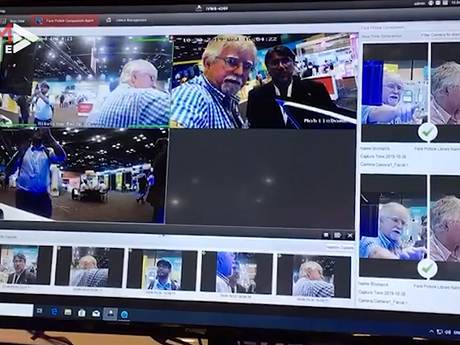
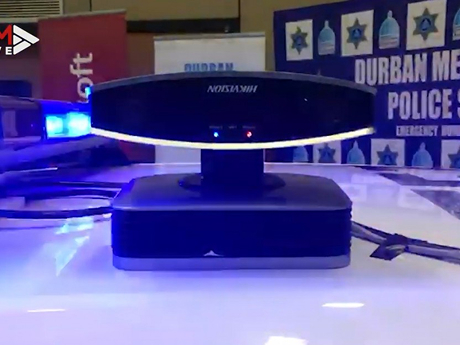
Microsoft’s MAPP patrol vehicle in Durban sports a facial recognition camera from China-based Hikvision. Photos taken from Multimedia Live presentation, ‘Metro police go high-tech for festive season.
Some of the most high-profile city police forces are using Genetec and Microsoft for video surveillance and analytics.
Through a public-private partnership called Operation Shield, Atlanta’s camera network has grown from 17 downtown cameras to a wide net of 10,600 cameras that officials hope will soon cover all city quadrants. Genetec and Microsoft Azure power the CCTV network.
On June 14, Atlanta’s Chief of Police, Erika Shields, resigned after APD cops shot and killed a 27-year-old Black man, Rayshard Brooks. Last month, six Atlanta police officers were charged for using excessive force against protesters of police violence.
In 2019, Atlanta Police Foundation COO Marshall Freeman told me the foundation had just completed a “department-wide rollout” for Microsoft Aware (Domain Awareness System). Freeman said the Atlanta Police Department uses Microsoft machine learning to correlate data, and plans to add Microsoft’s video analytics. “We can always continue to go back to Microsoft and have the builders expand on the technology and continue to build out the platform,” he added.
In Chicago, 35,000 cameras cover the city with a plug-in surveillance network. The back-end currently uses Genetec Stratocast and Genetec’s Federation service, which manages access to cameras across a federated network of CCTV cameras — a network of camera networks, so to speak. In 2017, Genetec custom-built their Citigraf platform for the Chicago Police Department — the second-largest police force in the country. In 2017, Genetec custom-built their Citigraf platform for the Chicago Police Department — the second-largest police force in the country — as a way to make sense of the department’s vast array of data.
CITIGRAF

Genetec Citigraf on Microsoft Azure. Data ingested for correlations, monitoring, and alerts includes Computer Aided Dispatch data, gunshot detection from ShotSpotter, automatic license plate reader cameras, American Community Survey (census) data, CCTVs on Genetec’s VMS, various communications and intrusion alerts, Geographic Information Systems data, and database components like incidents and arrests.
Powered by Microsoft Azure, Citigraf ingests information from surveillance sensors and database records. Using real-time and historical data, it performs calculations, visualizations, alerts, and other tasks to create “deep situational awareness” for the CPD. Microsoft is partnering with Genetec to build a “correlation engine” to make sense of the surveillance data.
Chicago’s police force has a brutal history of racism, corruption, and even two decades’ worth of torturing suspects. During police violence protests following Floyd’s murder, the CPD attacked and beat protesters, including five Black protesters to the point of hospitalization.
CITIGRAF
Genetec Citigraf on Microsoft Azure. Data ingested for correlations, monitoring, and alerts includes Computer Aided Dispatch data, gunshot detection from ShotSpotter, automatic license plate reader cameras, American Community Survey (census) data, CCTVs on Genetec’s VMS, various communications and intrusion alerts, Geographic Information Systems data, and database components like incidents and arrests.
CITIGRAF
Genetec Citigraf on Microsoft Azure. Data ingested for correlations, monitoring, and alerts includes Computer Aided Dispatch data, gunshot detection from ShotSpotter, automatic license plate reader cameras, American Community Survey (census) data, CCTVs on Genetec’s VMS, various communications and intrusion alerts, Geographic Information Systems data, and database components like incidents and arrests.
Chicago’s police force has a brutal history of racism, corruption, and even two decades’ worth of torturing suspects. During police violence protests following Floyd’s murder, the CPD attacked and beat protesters, including five Black protesters to the point of hospitalization
In 2017, Genetec custom-built their Citigraf platform for the Chicago Police Department — the second-largest police force in the country — as a way to make sense of the department’s vast array of data. Powered by Microsoft Azure, Citigraf ingests information from surveillance sensors and database records. Using real-time and historical data, it performs calculations, visualizations, alerts, and other tasks to create “deep situational awareness” for the CPD. Microsoft is partnering with Genetec to build a “correlation engine” to make sense of the surveillance data.