In the wake of 9/11, Microsoft made major contributions to centralized intelligence centers for law enforcement agencies. Around 2009, it began working on a surveillance platform for the NYPD called the Domain Awareness System, or DAS, which was unveiled to the public in 2012. The system was built with leadership from Microsoft along with NYPD officer
While some details about the DAS have been disclosed to the public, many are still missing. The most comprehensive account to date appeared in a 2017 paper by NYPD officers
The DAS integrates disparate sources of information to perform three core functions: real-time alerting, investigations, and police analytics.
Through the DAS, the NYPD watches the personal movements of the entire city. In its early days, the system ingested information from closed-circuit TV cameras, environmental sensors (to detect radiation and dangerous chemicals), and automatic license plate readers, or ALPRs. By 2010, it began adding geocoded NYPD records of complaints, arrests, 911 calls, and warrants “to give context to the sensor data.” Thereafter, it added video analytics, automatic pattern recognition, predictive policing, and a mobile app for cops.
By 2016, the system had ingested 2 billion license plate images from ALPR cameras (3 million reads per day, archived for five years), 15 million complaints, more than 33 billion public records, over 9,000 NYPD and privately operated camera feeds, videos from 20,000-plus body cameras, and more. To make sense of it all, analytics algorithms pick out relevant data, including for predictive policing.
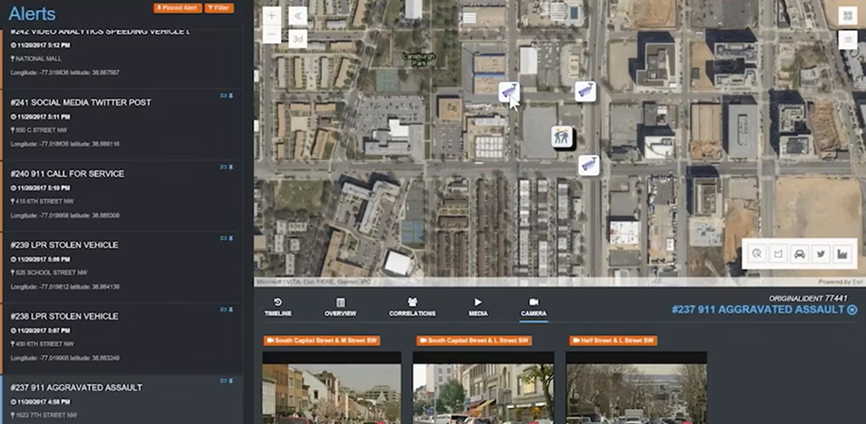
A snapshot of the Microsoft Domain Awareness System — also called Microsoft Aware — desktop interface. Photo taken from Microsoft presentation titled “Always Aware,” by John Manning and Kirk Arthur. Image: Microsoft presentation
In the wake of 9/11, Microsoft made major contributions to centralized intelligence centers for law enforcement agencies. Around 2009, it began working on a surveillance platform for the NYPD called the Domain Awareness System, or DAS, which was unveiled to the public in 2012. The system was built with leadership from Microsoft along with NYPD officer
NATIONWIDE PROTESTS AGAINST racist policing have brought new scrutiny onto big tech companies like Facebook, which is under boycott by advertisers over hate speech directed at people of
color, and Amazon, called out for aiding police surveillance. But Microsoft, which has largely escaped criticism, is knee-deep in services for law enforcement, fostering an ecosystem of companies that provide police with software using Microsoft’s cloud and other platforms. The full story of these ties highlights how the tech sector is increasingly entangled in intimate, ongoing relationships with police departments.
Microsoft’s links to law enforcement agencies have been obscured by the company, whose public response to the outrage that followed the murder of George Floyd has focused on facial recognition software. This misdirects attention away from Microsoft’s own mass surveillance platform for cops, the Domain Awareness System, built for the New York Police Department and later expanded to Atlanta, Brazil, and Singapore. It also obscures that Microsoft has partnered with scores of police surveillance vendors who run their products on a “Government Cloud” supplied by the company’s Azure division and that it is pushing platforms to wire police field operations, including drones, robots, and other devices.
Last month, AI supergiant and Department of Defense contractor Anthropic found itself embroiled with the Pentagon over the use of its AI for military purposes. On Feb. 14, Axios reported that the Pentagon was considering severing ties with Anthropic, which insisted on guardrails for its use of AI by the military. The conflict became public two days after the press revealed the American military used Anthropic’s Claude AI to help capture Venezuelan President Nicolás Maduro.
press revealed the American military used Anthropic’s Claude AI to help capture Venezuelan President Nicolás Maduro.
Tensions soon boiled over. Anthropic pushed back, and on Feb. 24, U.S. Defense Secretary Pete Hegseth issued an ultimatum: allow unrestricted use of Anthropic’s platform by the Department of Defense or get canceled. Trump followed suit, threatening to ban all federal agencies from using Anthropic’s technology and label the company a supply chain risk. On March 5, the Pentagon followed through, stating it has “officially informed Anthropic leadership the company and its products are deemed a supply chain risk, effective immediately.” This marks the first time such a sanction has been applied to a U.S. company. In response, Anthropic is suing the Pentagon over the risk label.
According to the company’s public relations, many media accounts and some tech workers, the episode is proof that the corporation aims to “do good” and put people over profits.
But is this really true? Is Anthropic really concerned with the lives shattered by U.S. militarism, and the American Empire in general, or is it pushing familiar Big Tech public relations asserting commitments to humanitarian values?
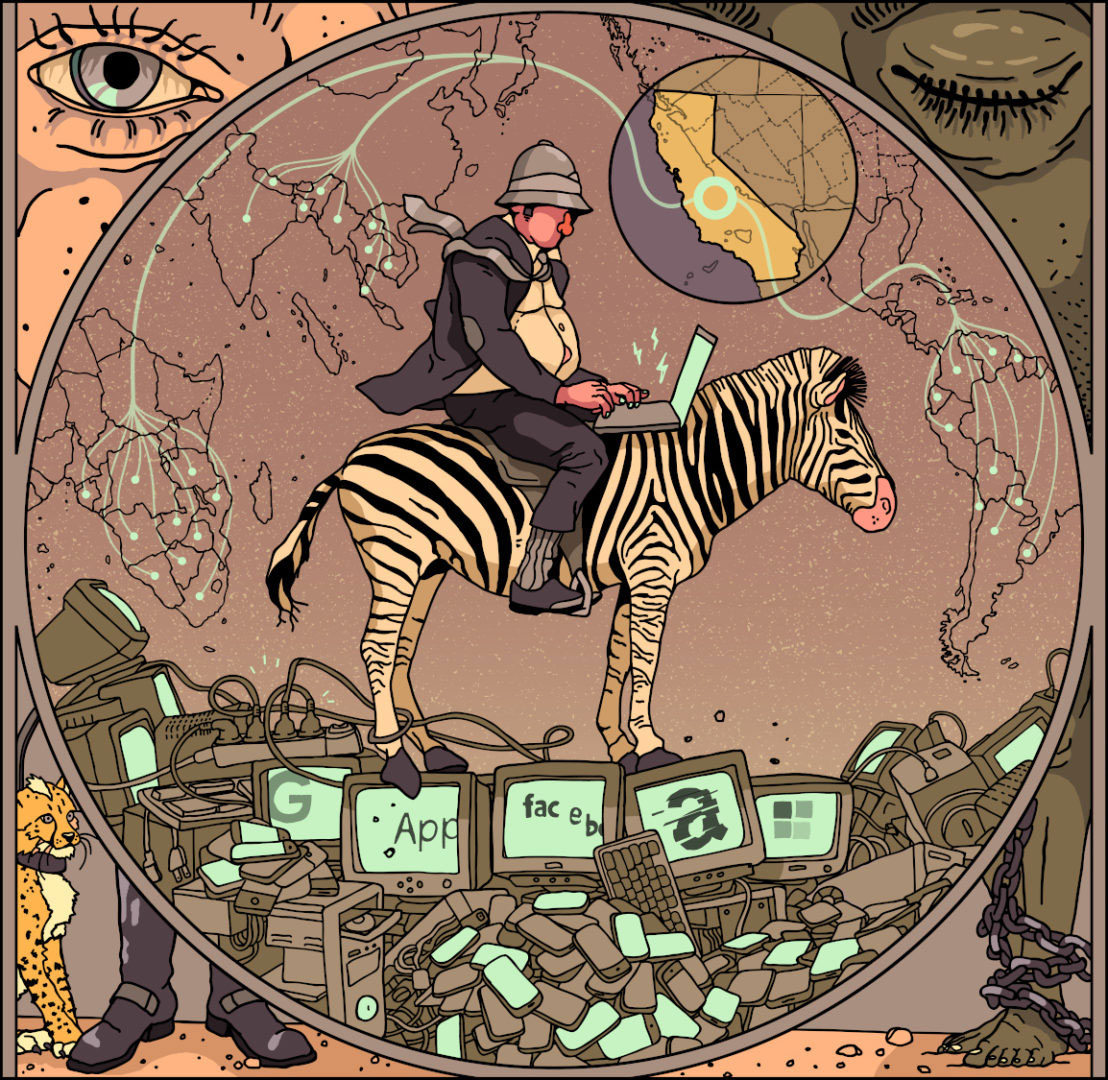
The answer is unquestionably the latter. Anthropic, which was founded in 2021, was happily offering its services to the military prior to this episode; and it is not in any meaningful way “resisting” the Pentagon. Anthropic remains woven into the fabric of the American Empire by virtue of its attempt to colonize the global AI economy in conjunction with other U.S. tech giants. This cannot be separated from the military applications of its technology.
Let’s dig in.
Partners in militarism: Anthropic’s services to American Empire are not new
In Nov. 7, 2024, Palantir proudly announced “a partnership with Amazon Web Services (AWS) to provide U.S. intelligence and defense agencies access to the Claude 3 and 3.5 family of models on AWS.” The partnership would “[allow] for an integrated suite of technology to operationalize the use of Claude within Palantir’s AI Platform (AIP).” The arrangement, Palantir stated, “will equip U.S. defense and intelligence organizations with powerful AI tools that can rapidly process and analyze vast amounts of complex data.”
Palantir played a central role assisting the U.S. military for its operations in the Middle East. It provided a “God’s-eye view” of Afghanistan and a data processing backbone for U.S. intelligence in Iraq. After building big data analytics systems on the battlefield, it sold its tools back to U.S. police departments, what’s sometimes called the “imperial boomerang.”
On July 14, 2025, Anthropic proudly announced a $200 million contract with the Department of Defense to “advance U.S. national security.” Details, while vague, included “Exchanging technical insights, performance data, and operational feedback to accelerate responsible AI adoption across the defense enterprise.”
This forms the backdrop for Anthropic’s recent “resistance” to the Pentagon. But what does that “resistance” entail? The company only stipulated two “restrictions” on the use of its technology by the U.S. military. First, that Anthropic not be used to guide autonomous weapons (meaning, a human must pull the trigger if munitions are fired). And second, that Anthropic not be used for the mass surveillance of Americans. The rest of the world is, apparently, fair game.
In reality, Anthropic openly embraces U.S. militarism and American supremacy. It has no problem with the well-documented history of U.S. war crimes, the devastation to populations throughout the world and the crimes of its military allies, such as Israel, receiving its advanced weaponry.
This helps explain why Anthropic’s AI is now being used for “intelligence assessments, target identification and simulating battle scenarios” in Iran. The company “was a step ahead of its rivals,” such as Google, OpenAI and xAI, “thanks to its partnership with Palantir,” the press reported.
While this controversy unfolded, Anthropic also dropped its promise to keep a high bar on general safety measures. According to this provision, the Responsible Scaling Policy, Anthropic would refrain from training an AI system unless it could guarantee in advance that its safety measures were adequate. The AI giant decided to remove this restriction because it would disadvantage them against competitors like OpenAI.
U.S. economic domination goes hand-in-hand with war
There is another theme on which the left is near-universally silent: the economic dominance of the United States in the global economy. The tech pseudo-left has, at times, been vocal about Big Tech services provided to the U.S. military. This dates back to protests at Google in 2017 against its development of drone analytics for the military via Project Maven. Yet this ignores the fact that American economic supremacy goes hand-in-hand with war. In the aftermath of World War II, elite policy planners wrote that the U.S. owns about half the world’s wealth, but only houses 6.3% of the world’s population, a disparity which “cannot fail to be the object of envy and resentment.” The goal was to “maintain this position of disparity,” a task that required dispensing with “the luxury of altruism and world-benefaction.”
To ignore Anthropic’s role in “maintaining this disparity,” with its $380 billion market cap and CEO worth $7 billion, is to pretend that the left hand doesn’t know what the right hand is doing. Wars waged by the United States and its allies are largely a violent means to preserve the economic “disparity” between the U.S. and the rest of the world. Under this neo-colonial arrangement, the Global South is to fulfill its role as supplier of raw materials and cheap labor, while the U.S. monopolizes the most lucrative parts of the global economy, with Big Tech at the helm. In other words, the American war machine is unleashed on societies in order to maintain the globally unequal exchange and division of labor.
Anthropic offers no objections to a global status quo where the United States, which now has 4% of the world’s population, one third of the wealth, and almost half the financial assets, continues to exploit the poor people of the world. Rather, it holds that democracies “must work together to ensure AI development strengthens democratic values globally by maintaining technological leadership to protect against authoritarian misuse.” This tracks with the New Cold War ideology of its high-profile CEO, Dario Amodei, a China hawk who pits the “democratic” West against the authoritarian Chinese. In January, Amodei said Trump’s decision to allow the sale of some AI chips to China is akin to “selling nuclear weapons to North Korea.”
Just one year prior, following the release of DeepSeek-R1 in 2025, Amodei penned an article calling for export controls on China so that the U.S. and other “democratic nations” can maintain a “unipolar world” where “only the U.S. and its allies” have the cutting edge AI models and “take a commanding and long-lasting lead on the global stage.”
If Amodei were even slightly humanitarian in his worldview, he would publicly oppose the flagrant violations of international law, war crimes, genocidal violence of the U.S. and its allies, and sever ties with the military. Instead, the company boasts it is “very proud” to work with the Department of Defense. “Our most important priority right now,” Anthropic stated last week, “is making sure that our warfighters and national security experts are not deprived of important tools in the middle of major combat operations.”
In other words, Anthropic and its allegedly “ethical” CEO Amodei, are full-throated American supremacists bolstering the U.S. Empire, and its violent wars, at the highest level. The most recent “stand” against the Pentagon is pure theater.
ATIONWIDE PROTESTS AGAINST racist policing have brought new scrutiny onto big tech companies like Facebook, which is under boycott by advertisers over hate speech directed at people of
color, and Amazon, called out for aiding police surveillance. But Microsoft, which has largely escaped criticism, is knee-deep in services for law enforcement, fostering an ecosystem of companies that provide police with software using Microsoft’s cloud and other platforms. The full story of these ties highlights how the tech sector is increasingly entangled in intimate, ongoing relationships with police departments.
Microsoft’s links to law enforcement agencies have been obscured by the company, whose public response to the outrage that followed the murder of George Floyd has focused on facial recognition software. This misdirects attention away from Microsoft’s own mass surveillance platform for cops, the Domain Awareness System, built for the New York Police Department and later expanded to Atlanta, Brazil, and Singapore. It also obscures that Microsoft has partnered with scores of police surveillance vendors who run their products on a “Government Cloud” supplied by the company’s Azure division and that it is pushing platforms to wire police field operations, including drones, robots, and other devices.
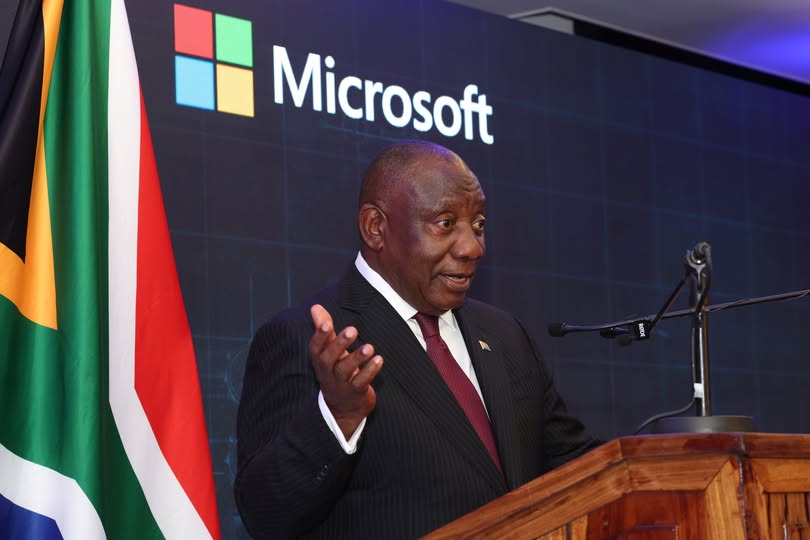
President Cyril Ramaphosa has described Microsoft South Africa’s investment of billions of Rands in artificial intelligence (AI) infrastructure as a momentous occasion which has come at the right time as the country hosts the Group of Twenty (G20) Summit, later this year.
“Microsoft’s commitment to supporting South Africa’s transition to a high-tech economy comes at a pivotal time, when South Africa is hosting the G20. Using AI for sustainable development is among the priorities of our G20 Presidency,” he said.
The President was delivering remarks at the Microsoft investment announcement in Bryanston, Johannesburg, on Thursday.
Microsoft’s Vice Chair and President, Brad Smith, announced that Microsoft will invest R5.4 billion to expand its cloud and AI infrastructure in South Africa to meet the growing demand for Azure services in the SADC region.
This investment builds on the company’s R 20.4 billion investment over the past three years to establish the nation’s first enterprise-grade datacentres in Johannesburg and Cape Town.
The President said the Artificial Intelligence, Data Governance and Innovation for Sustainable Development Task Force will lead this stream, and he looked forward to engaging with the Business 20 (B20) and other industry stakeholders in support of the task force’s work.
The President lauded Microsoft for its continuous investments in South Africa, describing it as an “American company with an African heart”.
“The company’s commitment to Africa, and to South Africa, has been solid, dependable and impressive. Microsoft has had a constant presence in South Africa virtually since the dawn of our democracy, having opened up its first offices here in 1992.
“Since then, Microsoft has substantially expanded its local footprint, and now has thousands of partners and customers. The company’s commitment to skills and capacity building is impressive,” he said.
President Ramaphosa commended Microsoft’s plans to train one million South Africans in AI skills, machine learning and cybersecurity by 2026.
“Microsoft’s plans to train one million South Africans in AI skills, machine learning and cybersecurity by 2026 is immensely encouraging.
“For a country such as ours, with such a high youth unemployment rate, this comprehensive training will not only prepare young people for jobs in high-tech industries. It will also facilitate self-employment,” he said.
This will contribute to a new generation of tech and software entrepreneurs that will bring innovation and high-tech solutions that support economic growth and enhance the country’s competitiveness.
The President outlined that South Africa is developing a National AI Policy that seeks to position the country as a leader in AI innovation, while at the same time, addressing its ethical, economic and societal implications.
“We must heed the words of the UN Secretary-General António Guterres that Artificial Intelligence without ‘guard-rails’ could further exacerbate inequalities and digital divides. The AI revolution is a catalyst for job creation, particularly for young people,” he said.
Last week, at the annual lekgotla of Basic Education Sector, the President said that future-proofing the country’s education system means coming to terms with the reality that the first fully digital generation is already in high school.
The next generation, Generation Beta, will be immersed in tech and AI from birth, and will enter a world of work that is light years away from what it is today.
“Building a robust AI talent pool is therefore critical. The application of AI will need to be integrated into educational curricula. Specialised training programmes will need to be offered and strong partnerships will need to be forged between academia and industry.
“As part of its commitment to digital transformation for sustainable development, Microsoft has invested in AI skills training for SMMEs. It has dedicated considerable resources into supporting black-owned companies pioneering 4IR technologies,” the President said.
President Ramaphosa further emphasised that he has high expectations that the county’s G20 Presidency will result in tangible outcomes, both expanding the global digital economy and levelling the AI playing field for the benefit of all.
“Our country and continent has huge potential, driven by the talents and energies of our people. It is up to all of us, working in partnership, to ensure that AI and its associated technologies do not deepen the technology divide, but narrow it.
“As we look towards hosting the G20 Summit later this year, we are committed to ensuring that the adoption of new technologies catalyses Africa’s growth, industrialisation and progress. We are excited about partnering with Microsoft to make this a reality,” the President said. – SAnews.gov.za
NATIONWIDE PROTESTS AGAINST racist policing have brought new scrutiny onto big tech companies like Facebook, which is under boycott by advertisers over hate speech directed at people of
color, and Amazon, called out for aiding police surveillance. But Microsoft, which has largely escaped criticism, is knee-deep in services for law enforcement, fostering an ecosystem of companies that provide police with software using Microsoft’s cloud and other platforms. The full story of these ties highlights how the tech sector is increasingly entangled in intimate, ongoing relationships with police departments.
Microsoft’s links to law enforcement agencies have been obscured by the company, whose public response to the outrage that followed the murder of George Floyd has focused on facial recognition software. This misdirects attention away from Microsoft’s own mass surveillance platform for cops, the Domain Awareness System, built for the New York Police Department and later expanded to Atlanta, Brazil, and Singapore. It also obscures that Microsoft has partnered with scores of police surveillance vendors who run their products on a “Government Cloud” supplied by the company’s Azure division and that it is pushing platforms to wire police field operations, including drones, robots, and other devices.
NATIONWIDE PROTESTS AGAINST racist policing have brought new scrutiny onto big tech companies like Facebook, which is under boycott by advertisers over hate speech directed at people of
color, and Amazon, called out for aiding police surveillance. But Microsoft, which has largely escaped criticism, is knee-deep in services for law enforcement, fostering an ecosystem of companies that provide police with software using Microsoft’s cloud and other platforms. The full story of these ties highlights how the tech sector is increasingly entangled in intimate, ongoing relationships with police departments.
Microsoft’s links to law enforcement agencies have been obscured by the company, whose public response to the outrage that followed the murder of George Floyd has focused on facial recognition software. This misdirects attention away from Microsoft’s own mass surveillance platform for cops, the Domain Awareness System, built for the New York Police Department and later expanded to Atlanta, Brazil, and Singapore. It also obscures that Microsoft has partnered with scores of police surveillance vendors who run their products on a “Government Cloud” supplied by the company’s Azure division and that it is pushing platforms to wire police field operations, including drones, robots, and other devices.
The NYPD has a history of police abuse, and civil rights and liberties advocates like Urban Justice Center’s Surveillance Technology Oversight Project have protested the system out of constitutional concerns, with little success to date.
While the DAS has received some attention from the press — and is fairly well-known among activists — there is more to the story of Microsoft policing services.
Over the years, Microsoft has grown its business through the expansion of its cloud services, in which storage capacity, servers, and software running on servers are rented out on a metered basis. One of its offerings, Azure Government, provides dedicated data hosting in exclusively domestic cloud centers so that the data never physically leaves the host country. In the U.S., Microsoft has built several Azure Government cloud centers for use by local, state, and federal organizations.
Unbeknownst to most people, Microsoft has a “Public Safety and Justice” division with staff who formerly worked in law enforcement. This is the true heart of the company’s policing services, though it has operated for years away from public view.
Microsoft’s police surveillance services are often opaque because the company sells little in the way of its own policing products. It instead offers an array of “general purpose” Azure cloud services, such as machine learning and predictive analytics tools like Power BI (business intelligence) and Cognitive Services, which can be used by law enforcement agencies and surveillance vendors to build their own software or solutions.
According to this concept, a multitude of surveillance and IoT sensor data is sent onto a “hot path” for fast use in command centers and onto a “cold path” to be used later by intelligence analysts looking for patterns. The data is streamed along through Microsoft’s Azure Stream Analytics product, stored on the Azure cloud, and enhanced by Microsoft analytics solutions like Power BI — providing a number of points at which Microsoft can make money.
While the “Connected Officer” was a conceptual exercise, the company’s real-world patrol solution is the Microsoft Advanced Patrol Platform, or MAPP. MAPP is an IoT platform for police patrol vehicles that integrates surveillance sensors and database records on the Azure cloud, including “dispatch information, driving directions, suspect history, a voice-activated license plate reader, a missing persons list, location-based crime bulletins, shift reports, and more.”
Microsoft says “the car is becoming the nerve center for law enforcement.”
Although it sports a Microsoft insignia on the hood and door, the physical vehicle the company uses to promote MAPP isn’t for sale by Microsoft, and you probably won’t see Microsoft-labeled cars driving around. Rather, Microsoft provides MAPP as a platform through which to transform existing cop cars into IoT surveillance vehicles: “It’s really about being able to take all this data and put it up in the cloud, being able to source that data with their data, and start making relevant information out of it,” said Beckham. Indeed, Microsoft says “the car is becoming the nerve center for law enforcement.” According to Beckham, the information collected and stored in the Azure cloud will help officers “identify bad actors” and “let the officers be aware of the environment that is going on around them.” As an example, he said, “We’re hoping with machine learning and AI in the future, we can start pattern matching” with MAPP vehicles providing data to help find “bad actors.”
According to this concept, a multitude of surveillance and IoT sensor data is sent onto a “hot path” for fast use in command centers and onto a “cold path” to be used later by intelligence analysts looking for patterns. The data is streamed along through Microsoft’s Azure Stream Analytics product, stored on the Azure cloud, and enhanced by Microsoft analytics solutions like Power BI — providing a number of points at which Microsoft can make money.
While the “Connected Officer” was a conceptual exercise, the company’s real-world patrol solution is the Microsoft Advanced Patrol Platform, or MAPP. MAPP is an IoT platform for police patrol vehicles that integrates surveillance sensors and database records on the Azure cloud, including “dispatch information, driving directions, suspect history, a voice-activated license plate reader, a missing persons list, location-based crime bulletins, shift reports, and more.”
In the wake of 9/11, Microsoft made major contributions to centralized intelligence centers for law enforcement agencies. Around 2009, it began working on a surveillance platform for the NYPD called the Domain Awareness System, or DAS, which was unveiled to the public in 2012. The system was built with leadership from Microsoft along with NYPD officers.
While some details about the DAS have been disclosed to the public, many are still missing. The most comprehensive account to date appeared in a 2017 paper by NYPD officers
The DAS integrates disparate sources of information to perform three core functions: real-time alerting, investigations, and police analytics.
Through the DAS, the NYPD watches the personal movements of the entire city. In its early days, the system ingested information from closed-circuit TV cameras, environmental sensors (to detect radiation and dangerous chemicals), and automatic license plate readers, or ALPRs. By 2010, it began adding geocoded NYPD records of complaints, arrests, 911 calls, and warrants “to give context to the sensor data.” Thereafter, it added video analytics, automatic pattern recognition, predictive policing, and a mobile app for cops.
By 2016, the system had ingested 2 billion license plate images from ALPR cameras (3 million reads per day, archived for five years), 15 million complaints, more than 33 billion public records, over 9,000 NYPD and privately operated camera feeds, videos from 20,000-plus body cameras, and more. To make sense of it all, analytics algorithms pick out relevant data, including for predictive policing.
A snapshot of the Microsoft Domain Awareness System — also called Microsoft Aware — desktop interface. Photo taken from Microsoft presentation titled “Always Aware,” by John Manning and Kirk Arthur.
Image: Microsoft presentation
The NYPD has a history of police abuse, and civil rights and liberties advocates like Urban Justice Center’s Surveillance Technology Oversight Project have protested the system out of constitutional concerns, with little success to date.
While the DAS has received some attention from the press — and is fairly well-known among activists — there is more to the story of Microsoft policing services.
Over the years, Microsoft has grown its business through the expansion of its cloud services, in which storage capacity, servers, and software running on servers are rented out on a metered basis. One of its offerings, Azure Government, provides dedicated data hosting in exclusively domestic cloud centers so that the data never physically leaves the host country. In the U.S., Microsoft has built several Azure Government cloud centers for use by local, state, and federal organizations
Unbeknownst to most people, Microsoft has a “Public Safety and Justice” division with staff who formerly worked in law enforcement. This is the true heart of the company’s policing services, though it has operated for years away from public view.
Microsoft’s police surveillance services are often opaque because the company sells little in the way of its own policing products. It instead offers an array of “general purpose” Azure cloud services, such as machine learning and predictive analytics tools like Power BI (business intelligence) and Cognitive Services, which can be used by law enforcement agencies and surveillance vendors to build their own software or solutions.
NATIONWIDE PROTESTS AGAINST racist policing have brought new scrutiny onto big tech companies like Facebook, which is under boycott by advertisers over hate speech directed at people of
color, and Amazon, called out for aiding police surveillance. But Microsoft, which has largely escaped criticism, is knee-deep in services for law enforcement, fostering an ecosystem of companies that provide police with software using Microsoft’s cloud and other platforms. The full story of these ties highlights how the tech sector is increasingly entangled in intimate, ongoing relationships with police departments.
Microsoft’s links to law enforcement agencies have been obscured by the company, whose public response to the outrage that followed the murder of George Floyd has focused on facial recognition software. This misdirects attention away from Microsoft’s own mass surveillance platform for cops, the Domain Awareness System, built for the New York Police Department and later expanded to Atlanta, Brazil, and Singapore. It also obscures that Microsoft has partnered with scores of police surveillance vendors who run their products on a “Government Cloud” supplied by the company’s Azure division and that it is pushing platforms to wire police field operations, including drones, robots, and other devices.
Genetec offers cloud-based CCTV and big data analytics for mass surveillance in major U.S. cities. Veritone provides facial recognition services to law enforcement agencies. And a wide range of partners provide high-tech policing equipment for the Microsoft Advanced Patrol Platform,
Genetec offers cloud-based CCTV and big data analytics for mass surveillance in major U.S. cities. Veritone provides facial recognition services to law enforcement agencies. And a wide range of partners provide high-tech policing equipment for the Microsoft Advanced Patrol Platform,
which turns cop cars into all-seeing surveillance patrols. All of this is conducted together with Microsoft and hosted on the Azure Government Cloud.
Last month, hundreds of Microsoft employees petitioned their CEO, Satya Nadella, to cancel contracts with law enforcement agencies, support Black Lives Matter, and endorse defunding the police. In response, Microsoft ignored the complaint and instead banned sales of its own facial recognition software to police in the United States, directing eyes away from Microsoft’s other contributions to police surveillance. The strategy worked: The press and activists alike praised the move, reinforcing Microsoft’s said position as a moral leader in tech.
Yet it’s not clear how long Microsoft will escape major scrutiny. Policing is increasingly done with active cooperation from tech companies, and Microsoft, along with Amazon and other cloud providers, is one of the major players in this space.
Because partnerships and services hosting third party vendors on the Azure cloud do not have to be announced to the public, it is impossible to know full extent of Microsoft’s involvement in the policing domain, or the status of publicly announced third party services, potentially including some of the previously announced relationships mentioned below.
People'sTECH
Short and sweet with a link or two to attract the mind and call to action!
Subscribe
Get updates in your inbox - and we won't share your email ever!
Get Involved
Help an independent team stay independent - we'd love to collaborate with you.