In the wake of 9/11, Microsoft made major contributions to centralized intelligence centers for law enforcement agencies. Around 2009, it began working on a surveillance platform for the NYPD called the Domain Awareness System, or DAS, which was unveiled to the public in 2012. The system was built with leadership from Microsoft along with NYPD officers.
While some details about the DAS have been disclosed to the public, many are still missing. The most comprehensive account to date appeared in a 2017 paper by NYPD officers
The DAS integrates disparate sources of information to perform three core functions: real-time alerting, investigations, and police analytics.
Through the DAS, the NYPD watches the personal movements of the entire city. In its early days, the system ingested information from closed-circuit TV cameras, environmental sensors (to detect radiation and dangerous chemicals), and automatic license plate readers, or ALPRs. By 2010, it began adding geocoded NYPD records of complaints, arrests, 911 calls, and warrants “to give context to the sensor data.” Thereafter, it added video analytics, automatic pattern recognition, predictive policing, and a mobile app for cops.
By 2016, the system had ingested 2 billion license plate images from ALPR cameras (3 million reads per day, archived for five years), 15 million complaints, more than 33 billion public records, over 9,000 NYPD and privately operated camera feeds, videos from 20,000-plus body cameras, and more. To make sense of it all, analytics algorithms pick out relevant data, including for predictive policing.
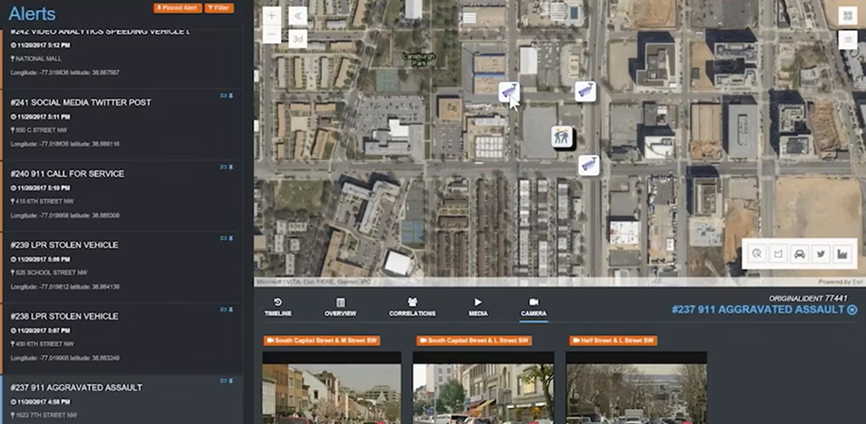
Image: Microsoft presentation
The NYPD has a history of police abuse, and civil rights and liberties advocates like Urban Justice Center’s Surveillance Technology Oversight Project have protested the system out of constitutional concerns, with little success to date.
While the DAS has received some attention from the press — and is fairly well-known among activists — there is more to the story of Microsoft policing services.
Over the years, Microsoft has grown its business through the expansion of its cloud services, in which storage capacity, servers, and software running on servers are rented out on a metered basis. One of its offerings, Azure Government, provides dedicated data hosting in exclusively domestic cloud centers so that the data never physically leaves the host country. In the U.S., Microsoft has built several Azure Government cloud centers for use by local, state, and federal organizations
Unbeknownst to most people, Microsoft has a “Public Safety and Justice” division with staff who formerly worked in law enforcement. This is the true heart of the company’s policing services, though it has operated for years away from public view.
Microsoft’s police surveillance services are often opaque because the company sells little in the way of its own policing products. It instead offers an array of “general purpose” Azure cloud services, such as machine learning and predictive analytics tools like Power BI (business intelligence) and Cognitive Services, which can be used by law enforcement agencies and surveillance vendors to build their own software or solutions.